Monday, August 15, 2011

DhanushKodi


Dhanushkodi or Danushkodi (Tamil : தனுஷ்கோடி) is a town/village at the southern tip of the Rameswaram island, at the eastern coast of the Tamil Nadu state of India.
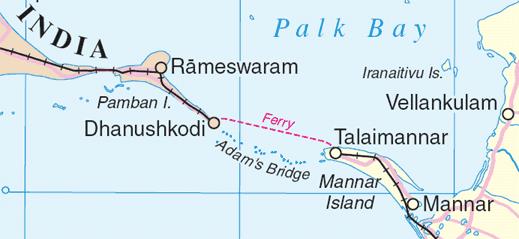
Dhanushkodi is situated in the South-East of Pamban. Danushkodi is about 18 miles (29 km) West of Talaimannar in Sri Lanka. The Dhanushkodi railway line running from Pamban Station was destroyed in the 1964 cyclone and a passenger train with over 100 passengers drowned in the sea.Dhanushkodi has the only land border between India and Sri Lanka which is one of the smallest in the world-just 50 yards in length on a shoal in Palk Strait.
Since Ceylon (now Sri Lanka) is just 19 miles (31 km) away, there were many ferry services between Dhanushkodi and Talaimannar of Ceylon, transporting travellers and goods across the sea. There were hotels, textile shops and dharmashalas catering to these pilgrims and travellers. The Railway line to Dhanushkodi–which did not touch Rameshwaram then and destroyed in the 1964 cyclone-went directly from Mandapam to Dhanushkodi. Dhanushkodi in those days had a railway station, a small railway hospital, a higher secondary school, a post office, customs and port offices etc. It was here in this island in January 1897, Swami Vivekananda after his triumphant visit to the west to attend parliament of religions held in USA in September 1893, set his foot on Indian soil from Columbo
Before the 1964 storm, there was a train service up to Dhanushkodi called Boat Mail from Madras Egmore (Now Chennai Egmore) and the train linked to a steamer for ferrying travellers to Ceylon.
On that fateful night (December 22) at 23.55 hours while entering Dhanushkodi railway station, the train No.653, Pamban-Dhanushkodi Passenger, a daily regular service which left Pamban with 110 passengers and 5 railway staff, was only few yards before Dhanushkodi Railway station when it was hit by a massive tidal wave. The whole train was washed away killing all 115 on board. All together over 1800 people died in the cyclonic storm. All dwelling houses and other structures in Dhanushkodi were marooned in the storm . The high tidal waves moved almost 10 kilometres onto this island and ruined the entire town. Pamban bridge was also washed away by the high tidal waves in this disaster. Eyewitness accounts recollected of how the surging waters stopped just short of the main temple at Rameshwaram where hundreds of people had taken refuge from the fury of the storm. Following this disaster, the Government of Madras declared the town as Ghost town and unfit for living after the storm.Only few fisherfolks now live there.Even though there was a railway line between Pamban and Dhanushkodi and a passenger train used to ply regularly, after the storm the tracks were damaged and in course of time, were covered by sand dunes and hence had to be abandoned. One has to reach Dhanushkodi either on foot along sea shore on the sand dunes or in jeeps and in tempos of fishermen.

A EXCAVATION IN RAMESWARAM STATION


Enchanting Rameshwaram


Rameswaram (Tamil: இராமேஸ்வரம், is a town in Ramanathapuram district in the Indian state of Tamil Nadu. It is located on Pamban Island separated from mainland India by the Pamban channel and is about 50 kilometres from Mannar Island, Sri Lanka. Pamban Island, also known as Rameswaram Island, is connected to mainland India by the Pamban Bridge.Together with Kashi, it is considered to be one of the holiest places in India to Hindus, and part of the Char Dham pilgrimages. Hence, it is a bustling pilgrim centre.
It is situated in the Gulf of Mannar at the very tip of the Indian peninsula. According to legend, this is the place from where Lord Rama built a bridge Ram Setu (also known as Adam's Bridge) across the sea to Lanka to rescue his consort Sita from her abductor Ravana. Both the Vaishnavites and Shaivites visit this pilgrimage centre which is known as the Varanasi of the south.
Ex-president of India, Dr. A.P.J. Abdul Kalam, hails from a fishing hamlet called Dhanushkodi situated on this island.

Thursday, May 5, 2011

Tuesday, May 3, 2011

ANAMALAI HILLS IN WESTERN GHATS


ANAMALAI HILLS IN WESTERN GHATS


We visited the Anamaliai hills this summer.We saw many places like Athirapalli , Valparai,Selaliparai, dams like Sholaiyur Dam , Nirar dam , Aliyar dam ,Green valleys,Tiger valley view points, temples like Balaji temple, SidhiBhudhi Vinayagar temple, Tea and Coffee estates , waterfalls and finally Pollachi .In Pollachi we saw the Masani Amman temple.In Alliyar we saw Vedhandiri Maharishi yoga and kayakalpa center and the Guru's Memorial .we spotted Hornbills, hawks,Lion tailed macaque ,Nilgiri tahr , Peacocks, Sambar deer,Wild doves , Bluejay ,Wild forest Squirrels, Forest Mushrooms , Woodpeckers,Mainas , Kingfisher and many exotic birds. Trees like Grapefruit , Oranges , pears , lemons and Papayas were in abundance.We also get to hear the cuckoos and Budgeriger birds sweet melodies.

Sunday, April 3, 2011

Ranganathittu Bird sanctuary , Srirangapatna


The Ranganathittu Bird Sanctuary is located about 5 km away from Srirangapatna. It is spread in an 57 acres area. The sanctuary is a small island on the banks of river Kaveri. It is a place of interest to all bird lovers. The sanctuary is a nesting and breeding center for all kinds of birds.

One can see species like the herons, egrets, white ibis. Also little cormorants, dantes, open billed stork etc. are also some of the birds that can be seen in island when one takes a round by a boat.

The best time of visit to the island is from June to October.Timmings: 9AM -6PM
Tickets :Rs.10 Boat ride Rs.10.

Mudumalai photos and Srirangapatinam


Srirangapatna - Abode of Lord Vishnu:

Situated just 13 Km from Mysore, Srirangapatna is surrounded by River Kaveri form all sides. The town gets its name from the famous Temple Ranganathaswamy Temple that dominates the landscape of the town. Due to Ranganathaswamy Temple, Srirangapatna is an important Vaishnavite site and is frequented by many pilgrims. Srirangapatna once served as the capital of Mysore when Hyder Ali and Tipu Sultan ruled over it. This brought the town into recognition then and made it historically important. Tipu Sultan built Srirangapatna as his fortress and used it to launch attacks on British. Tipu sultan built many buildings that are now the main attractions of the city for tourists.
Ranganathaswamy Temple:
As we are all aware, Lord Vishnu has taken various forms for the welfare and protection of various creations of Lord Brahma. One such Temple is Sri Jaganmohana Ranganatha Swamy Temple at Shivanasamudra in Mandya District of Karnataka State. The presiding Deity of the Temple is Sri Ranganatha, A form of Lord Vishnu sleeping on the bed of Adishesha, the sacred snake of Lord Vishnu himself with his Hood providing shelter to the Lord. The Temple is located on the banks of the river Cauvery.Altogether, there are 3 most sacred, powerful and important temples of Lord Ranganatha and each of them is known by a different name. The three temples are located at Srirangapatna, Shivanasamudra and Srirangam.It is beleived that on any given day starting from Sunrise to Sunset, if one visits all the three Temples and worships the deities and seeks the blessings, his Sins are washed off and he is blessed with Peace,Happiness and abundant wealth.

This is dedicated to Lord Vishnu as Ranganatha and is located inside the fort. Built in 9th century by Vijayanagara rulers, it is among the largest temples in Karnataka. Entire temple, with the intricate carvings and sculptures, is a marvel in itself. But the main attraction of the temple is the reclining image of Lord Vishnu on the great snake Ananta. The architecture of the temple amalgamates a bit of Hoysala as well as Vijayanagara styles. When Srirangapatna served as the capital of Mysore, it is said that both Hyder Ali and Tipu Sultan took good care of the temple. Inside the premises of the temple, there are shrines dedicated to Lord Krishna, Gowtama muni and River Cauvery. The images of Lord Srinivasa and Panchmukha Anjaneya adorn the inner walls of the temple. The pillars that are carved with 24 forms of Lord Vishnu also shows the skills of sculptors during that period.he sacred Deity of Lord Ranganatha known as Madhya Ranga worshipped and decorated with Flowers, Thulasi, etc. One can notice the Lord sleeping on the bed formed by the Sacred snake Adishesha. The speciality of this temple is that the snake is seven headed whereas in the remaining two Temples, the snake is five headed. The idol is believed to be a Shaligrama Shila or in other words a Black Fossil Stone.

See the Masinagudi route from ooty to Bandipur.
The road was excellent and ver smooth. I enjoyed the drive very much.

Gumbaz In Srirangapatinam:
Tipu Sultan, the tiger of Mysore, the great warrior who fought with the British empire, built Gumbaz in the midst of Lal Bagh, a beautiful garden. He built tombs for his father Hyder Ali and mother Fathima Begam (Fakr-Un-Nisa) in Gumbaz.
Place Statistics:
Type of Place: Mausoleum
Situated: Srirangapatna
Distance: 15 Km from Mysore
Transport: Well connected by road, can hire an autorikshaw from Srirangapatna
Timings: 8:00 a.m to 6:30 p.m


Mudumalai:
Mudumalai Wildlife Sanctuary is situated in the northwestern corner of Tamil Nadu at a distance of around 80 km from Coimbatore and 64 km from Udhagamandalam (also Ooty). It is also a part of the Nilgiri Biosphere reserve along with Bandipur National Park in Karnataka and Wynad Sanctuary in Kerala. Langur, bonnet macaque, tiger, leopard, wild dog, hyena, jackal, sloth bear, elephants, gaur, sambar, spotted deer, Indian muntjac, mouse deer, wild boar, rodent and flying squirrel are part of the wildlife in Mudumalai. It has a rich bird life that includes Malabar trogan, Grey hornbill, crested hawk eagle, crested serpent eagle, etc.The best time to visit the reserve is from February to June.

Karanataka trip May 2010


This is the Bhanarghatta zoo near Bangalore.This was during May 2010 vacation tour.We celebrated Mehul's 9th birthday in Country club ,Bangalore during this trip.
One photo containing a house in the green field was in Masinagudi at the foothills of Nilgiri Mountains in Tamilnadu.